What Your Spare-Air Plan Actually Covers
A one-litre bottle is not a second air supply. Working out honestly what it buys you, which failures it covers, and the one scenario it does nothing about.

Ask a room of hose divers what their redundancy plan is and most will answer by pointing at the bottle on their harness. That is a start, not a plan. A one-litre cylinder at 200 bar holds about 200 litres of air, which at a normal working breathing rate is somewhere between three and five minutes at the surface — and less than that at depth, because each breath consumes more gas the deeper you are. So the honest question is not "do I have a bottle" but "what exactly do those three minutes cover, and what do I do if the thing that went wrong is not on that list".
What it genuinely covers
The bottle covers the failures that stop the machine delivering air while you are still able to move freely: a flat battery, a unit swamped or knocked in, a severed hose, a failed fitting. In every one of those the hose goes slack or the breath stops, and you have a clean, well-defined problem: switch to the bottle, take a normal breath, and ascend at a controlled rate. Practise that switch on the surface until it is boring and those scenarios become paperwork rather than emergencies.

What it does not cover
The scenario the bottle does nothing about is the one where you cannot ascend. A hose caught under structure above you, a weight belt you cannot reach, a net around your legs — none of those are air problems, and none of them are solved by more air. They are solved by carrying a cutting tool where your hand already goes, by diving a harness you can release in the dark, and by never entering a space the hose cannot follow you out of. Divers who buy a bigger bottle instead of a knife have bought the wrong redundancy.

Building an honest plan
- Air: a spare-air bottle, practised to the point of boredom
- Cutting: a line cutter on the harness, where your hand already goes
- Release: a harness you can drop in the dark, tested in a pool
- Signalling: a whistle or a surface marker that is not buried in a pocket
- Exit: an exit you have already walked, not one you plan to find
- Team: somebody on the surface who knows the shutdown and the signal

The rule that replaces all of it
The most effective redundancy on a hose is not equipment. It is not entering anything the hose cannot be pulled back out of. A hose follows a route you chose on the surface, and if your route cannot be reversed — a gap between two rocks, a pipe, a net, a wreck opening — then you have created a failure that no amount of air solves. Divers who keep that rule do not need much else. Divers who break it are relying on a three-minute bottle to get them out of a problem that will take longer than three minutes to solve.
The short version
- A one-litre bottle is three to five minutes at the surface, and less at depth. It buys time, not a second dive.
- It covers air failures: flat battery, severed hose, swamped unit.
- It does nothing about entanglement, weight or restricted exits. Those need a cutter, a releasable harness and route discipline.
- Mount the bottle where you can reach it one-handed, in gloves, without looking.
- Practise the switch until it is boring. Unpractised redundancy is equipment, not a plan.
- The best redundancy is not entering anywhere the hose cannot come back out of.
FAQ
Do I need a diving certification?
How deep can I go?
What happens if the battery runs low?
Keep reading

Scuba Tank vs. Tankless Hookah Diving: The Complete 2026 Comparison
Cost, bottom time, depth, safety and logistics — an honest, side-by-side look at when a surface-supply system beats a tank, and when it doesn’t.

How Deep Can You Go on a Hookah System?
Rated depth is not tested depth, and hose length is not depth at all. The three numbers people confuse, and the no-decompression limits that apply to a hose exactly as they do to a tank.
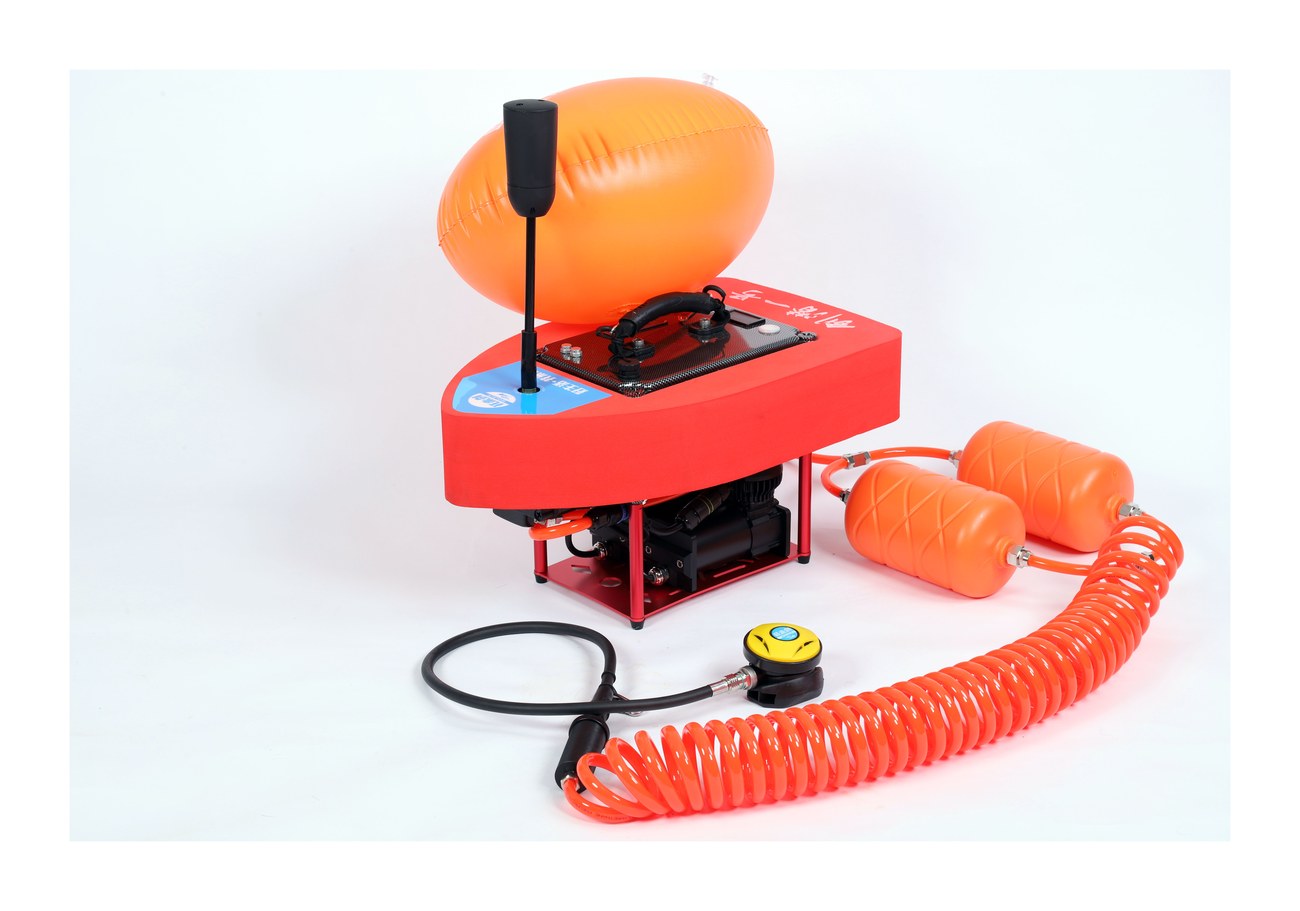
S6 vs S7 vs S9 vs S77: Which WOLACH Is Right for You?
Four machines, one air path, three numbers that decide it. How to pick by the diving you actually do rather than the depth rating you aspire to.