Runtime and Turn Points: Replacing the Gauge
A hose dive has no reserve pressure, so you have to invent one. How to pick a turn point, why the machine’s runtime number is not your dive time, and what to do when the battery is the thing counting.

Every scuba diver has an internal mechanism for ending a dive, and it was installed over a whole course: turn the dive at a reserve pressure, arrive at the exit with something left, never plan to the edge of the cylinder. It is one of the genuinely good habits the sport has, and surface supply quietly removes the instrument that drives it. There is no reserve pressure on a hose. There is a battery, and the battery does not talk to the diver. So the mechanism has to be rebuilt deliberately, out of things you can see from under the water.
Rated runtime is not your dive time
When a model is described as offering up to ten hours, that figure comes from a test load at a shallow depth, and it is a specification rather than a promise about your day. Real runtime is shorter and varies with three things: depth, because delivering air against pressure costs power; workload, because a diver finning hard against a current draws more air than one hovering; and temperature, because cold cells give up capacity faster. None of those are accounted for in a headline number, so the honest way to use it is as a ceiling. Plan a dive at roughly half of it and you will be right far more often than not.

Pick a turn point before you get in
Choose one trigger and treat it the way a scuba diver treats reserve pressure. Time is the easiest and works for most recreational dives: decide the duration on the surface, agree it with your buddy, and treat the number as a commitment rather than a suggestion. Depth plus time is better if you are working, because it captures the fact that deep minutes cost more. Work completed is best of all for a job dive — "when the third panel is clean" — because it is the thing you actually care about and it cannot drift in the way a clock does when the diving is pleasant.

Three triggers that end a dive early
- The breath changes — harder, pulsing, or weaker than it was ten minutes ago
- The surface team signals, whatever the reason; a surfaced signal outranks your plan
- The float has moved substantially, meaning the current is stronger than you planned for
- And the environmental one: you are cold enough that your hands are losing fine control
Measure your own runtime once
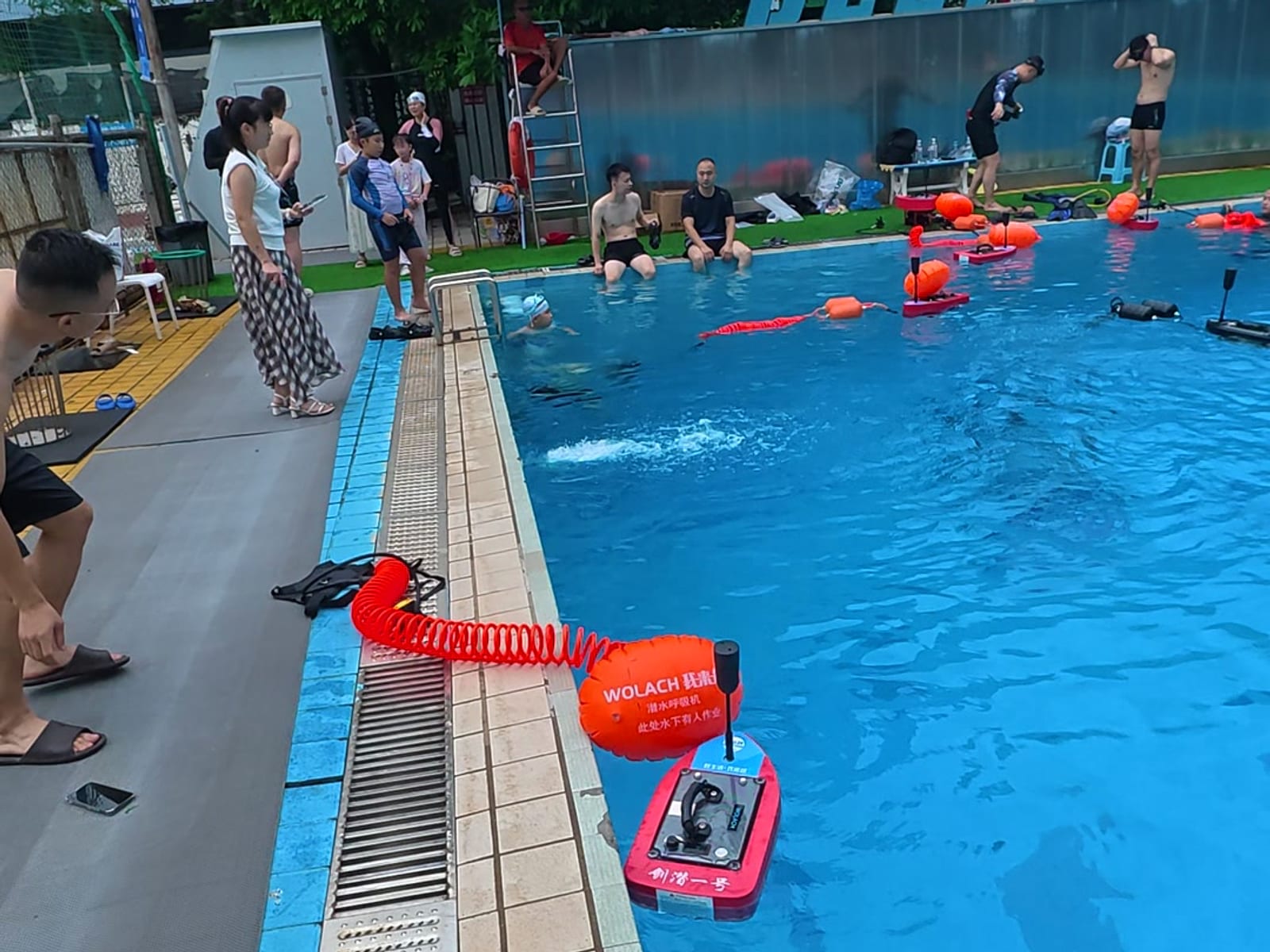
One habit turns the whole question from a guess into an estimate. Once a month, run the machine against a realistic load — a pool, a wall, a known depth — and time it from full charge to the point where delivery noticeably drops. Write the number down. After three months you have a personal runtime figure for your machine, in your conditions, and the planning becomes arithmetic rather than optimism. Owners who do this stop being surprised by a battery, because they know what it does rather than what it says on the box.
The honest margin
The margin you should keep is bigger than a scuba diver’s, for a simple reason: a scuba diver running low can surface anywhere and be finished. A hose diver running out has to get back to a specific piece of water, deal with a hose, and possibly swim to a boat. The reserve is not air, it is time and position. If the exit is a five-minute swim from where you are working, then five minutes is not margin, it is the trip home. Budget the return leg first and treat whatever remains as the dive.
The short version
- Rated runtime is a ceiling measured at a shallow depth. Plan dives at about half of it.
- Depth, workload and temperature all shorten real runtime. The headline number accounts for none of them.
- Pick one turn point — time, depth-plus-time, or work completed — and treat it as a commitment.
- Measure your own runtime monthly against a real load. Three data points beat any specification.
- Budget the return leg first, then treat what is left as the dive.
- Four triggers end a dive early: the breath changes, the surface signals, the float has moved, or you are losing fine control in your hands.
FAQ
Do I need a diving certification?
How deep can I go?
What happens if the battery runs low?
Keep reading

Scuba Tank vs. Tankless Hookah Diving: The Complete 2026 Comparison
Cost, bottom time, depth, safety and logistics — an honest, side-by-side look at when a surface-supply system beats a tank, and when it doesn’t.

How Deep Can You Go on a Hookah System?
Rated depth is not tested depth, and hose length is not depth at all. The three numbers people confuse, and the no-decompression limits that apply to a hose exactly as they do to a tank.
S6 vs S7 vs S9 vs S77: Which WOLACH Is Right for You?
Four machines, one air path, three numbers that decide it. How to pick by the diving you actually do rather than the depth rating you aspire to.