The WOLACH User Manual: Depth Limits, Rules and Service Intervals
The manual ships as a compliance document, so the parts that govern a dive are spread across eight chapters. What it actually requires — including two depth figures that are easy to mix up — with the full V1.5 PDF attached.
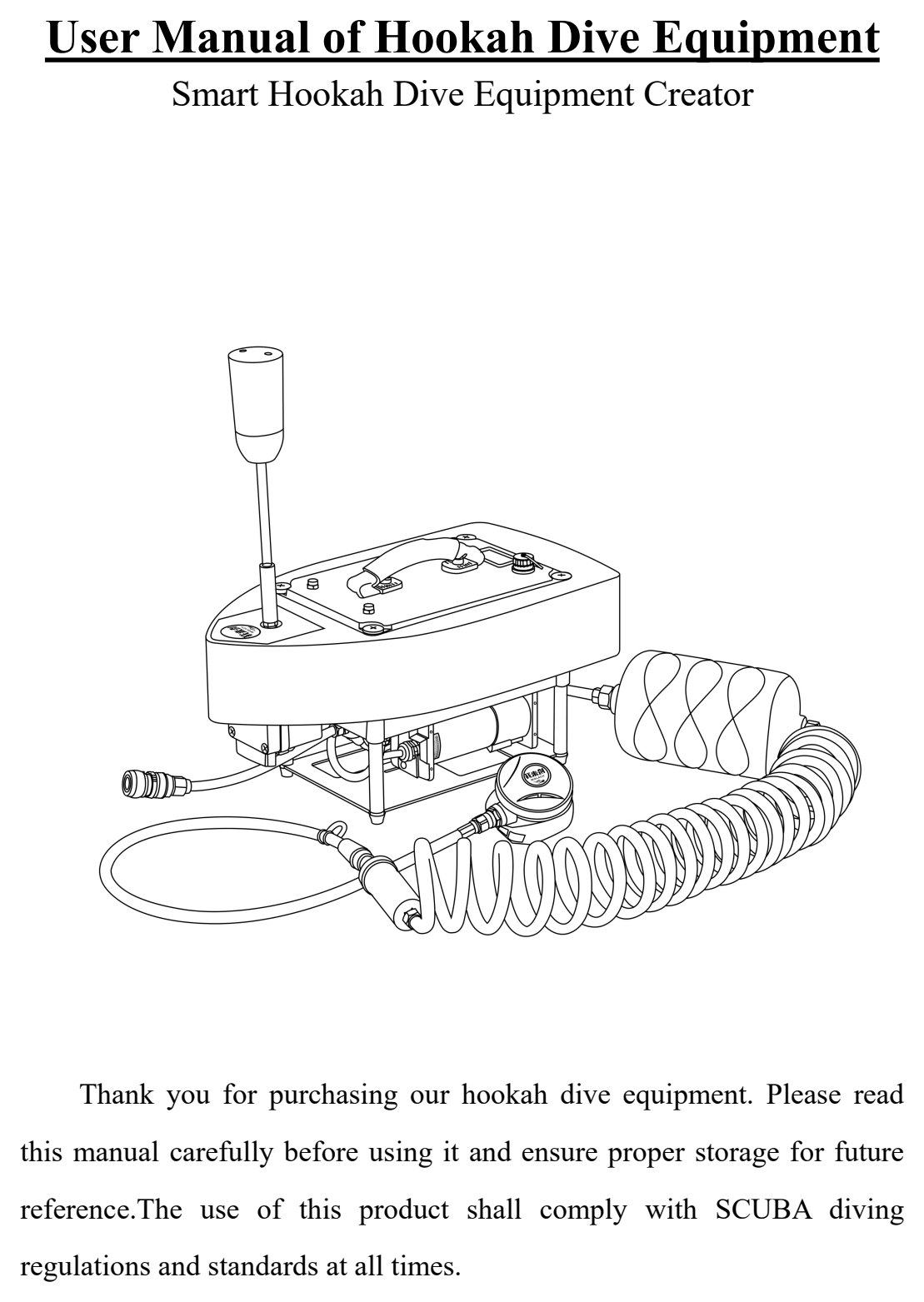
This is a working summary of the manufacturer's user manual — version 1.5, 26 pages, covering the S6, S7, S9 and S77. The full PDF is attached at the top of this page and is worth keeping on the boat, because the manual is written as a compliance document rather than as a guide. The numbers that govern your dives, the prohibitions and the service intervals are spread across eight chapters, and several of the most important ones are single sentences inside longer lists.
What follows is the part that changes how a dive is run. Where the manual and our product pages differ, we say so — and there is one place where that difference really matters.
The model codes, and why the numbers never seemed to match
The manual does not use the names we sell these machines under. It lists them as WLC-NO. codes, and if you have ever held a certificate or a customs document next to a product page and found that the model numbers did not correspond, this is the reason.
The codes are not arbitrary. They encode the runtime. An S6 is sold as the S6-3H, S6-4.5H, S6-6H or S6-10H, and the manual lists those same four machines as WLC-NO.1-3, WLC-NO.1-4, WLC-NO.1-6 and WLC-NO.1-10. The S7 appears as WLC-NO.2-5 and WLC-NO.2-8, matching the five and eight hour versions. The S9 is WLC-NO.3-3.5 and WLC-NO.3-6. The S77, which is a single five hour configuration, is WLC-NO.5-5.
Once you read the suffix as hours rather than as an arbitrary number, the manual and the shop page describe the same four machines.
Maximum depth in the manual, and what that number actually is
- S6 (WLC-NO.1-3 / -4 / -6 / -10): the manual gives 39 ft. That is 11.9 m — our laboratory maximum tested depth. The rated operating depth is within 8 m
- S7 (WLC-NO.2-5 / -8): the manual gives 52 ft (15.8 m). Again the laboratory figure; the rated operating depth is within 12 m
- S9 (WLC-NO.3-3.5 / -6): 65 ft (19.8 m), which matches the rated 20 m on the product page
- S77 (WLC-NO.5-5): 95 ft (29 m), matching the rated 0–29 m operating range
- Airflow at the same settings: 63 L/min on the S6, 73 L/min on the S7, 95 L/min on the S9, 160 L/min on the S77
- Two dangers sit alongside these figures: the dive depth must not exceed the length of the air supply pipe, and it must not exceed the product's maximum depth
The prohibitions worth reading twice
The manual carries a long list of things that are strictly forbidden, and most of them are the usual cautions. These are the ones that change how the machine is actually operated:
- Do not run the machine on land for more than one minute — the air pump is water-cooled, and the manual repeats this prohibition twice
- Do not charge for more than 15 hours, do not charge indoors, and do not charge in heat or direct sun
- Keep the unit at least 5 m from any heat source and away from fuel, alcohol or anything flammable
- Under-18s may not use the system, and the user must hold a diving certification such as OW or PADI
- Carry a dive computer on every dive
- Never knot the weight belt, and never allow the spring hose to kink
- The air intake must never be blocked and must never take in water or debris — this is the failure that destroys the motor
- No use in a thunderstorm, no use with a known or suspected fault, no use in rocks, wind, waves or current, and no use by anyone who cannot swim
- The draft line must not sit above the upper plane of the pontoon
- Do not open the fastening screws or sealant yourself: the manual notes the system holds high pressure and restricts internal work to trained service personnel
The pre-dive checks the manual actually requires
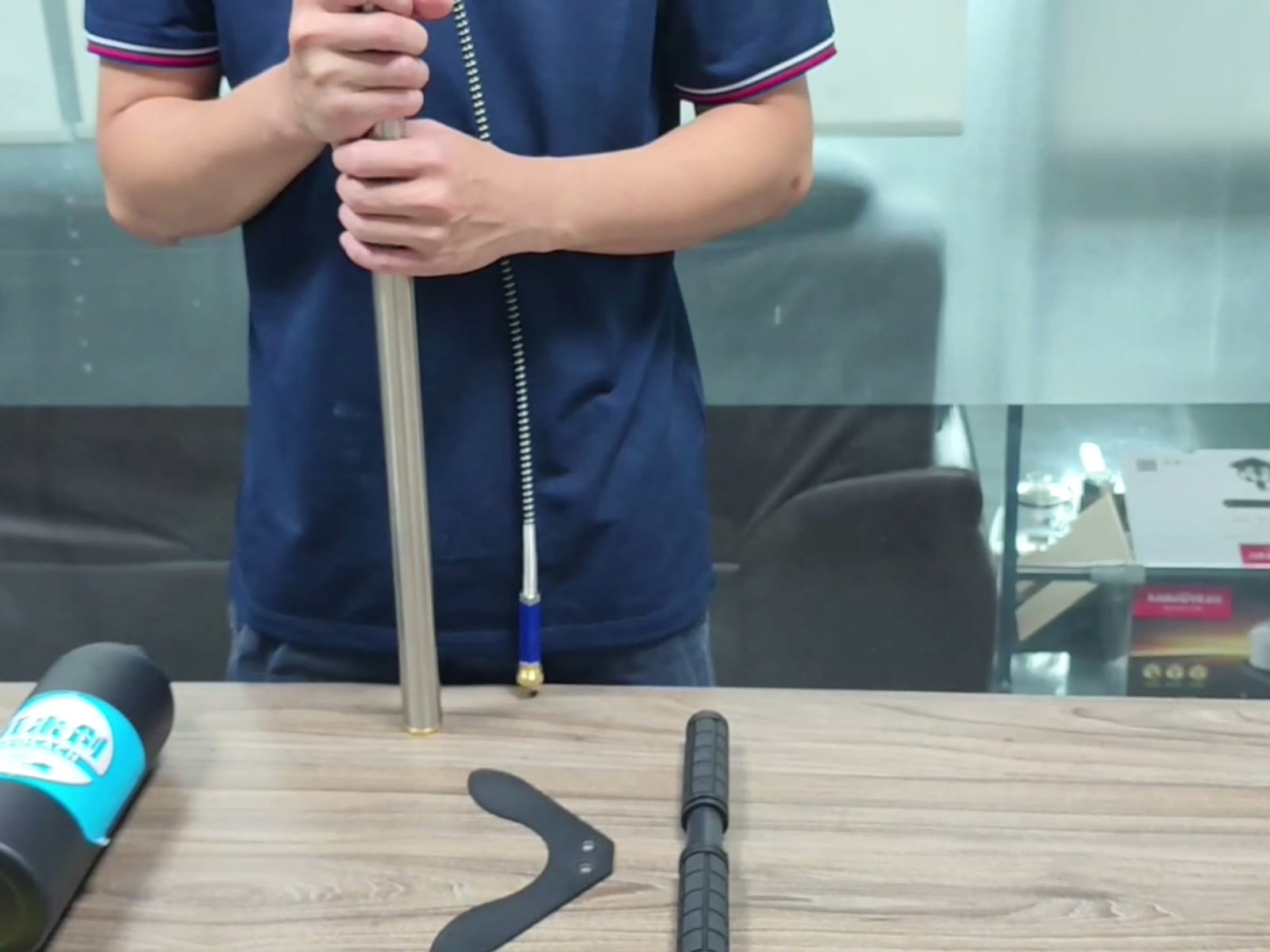
Chapter VI sets out a specific sequence, and it is shorter than most people assume. Connect the intake pipe, the air delivery pipe, the regulator and the filter, then confirm that every joint is tight. Start the machine and listen to it: the motor should run smoothly and without a dull note. If the noise is rough, the manual says switch off immediately and contact service rather than carry on. Check that the display is showing the battery level. Press the centre button on the second stage and confirm a clean burst of air, then put the mouthpiece in your mouth and breathe from it.
One behaviour reads like a fault and is not. Once the machine reaches its rated pressure it shuts down on its own. With no hose connected that happens in less than a second; with the hose connected it happens when the system reaches pressure. Pressing the centre button restarts it. If you have ever thought the unit cut out during setup, that is what you were watching.
The dive-planning rules the manual sets
The manual includes a recreational dive schedule and, more usefully, the general rules that go with it. These are transcribed from chapters VII and VIII rather than written by us, and a few are stricter than what most divers do by habit:
- Ascend no faster than 18 metres per minute — the manual adds that slower is fine or even better
- Use the correct depth or the next deeper one, and treat any dive planned to 10 m or shallower as a 10 m dive
- Use the correct bottom time or the next longer one
- In cold water or demanding conditions, plan 4 m deeper than the actual depth
- A three-minute safety stop at 5 m is required whenever you are within three pressure groups of the no-decompression limit, and after any dive to 30 m or deeper
- Repetitive dives run deep to shallow, and the repeat depth is limited to 30 m or shallower
- 42 m appears in the schedule for emergency use only, with an explicit instruction not to dive to it
- Do not work close to the schedule's limits — the manual asks for a conservative profile
- The buddy system is mandatory: two divers within 2 m of each other, never out of sight, able to reach and rescue each other within a minute
- Heart disease, cardiovascular or cerebrovascular disease and hypertension are listed as absolute contraindications
The manual states plainly that this is not a complete safety system
This is the sentence we would move to the front cover if we could. Section VIII states that the hookah apparatus is not a complete diving safety system, and that the user must carry at least one standby air source along with the usual equipment: a backup air supply or small spare cylinder, a dive computer, a knife, buoyancy control, and a surface signalling device.
That is a manufacturer telling you exactly what the machine is not, and it matches how we describe redundancy elsewhere in this section. A hose buys you time and a surface team; it does not give you a second air supply, and it does not give you a way up from depth if the pump stops. The standby cylinder is not an accessory to consider later.
Service intervals the manual specifies
- After every dive: flush the body with fresh water, keeping it clear of the charging port and the air intake, and run 200–300 ml of fresh water through the intake with the machine running to clear salt and residue
- Air filter element at the second stage: wash and dry after every dive, keep pieces in rotation, and replace each one after roughly 10 uses
- Activated carbon filter material: the manual advises replacing it after each dive, and notes that a spare pack ships with the unit which can be cleaned and reused
- Every 10 dives: open the valve plate and the cover, clean with fresh water, dry thoroughly and refit — the manual flags this again in the troubleshooting chapter
- Soak the equipment in fresh water for half an hour, then run the pump for about 10 seconds to expel the condensate
- Rinse the C-type quick-plug on the outlet pipe after every use; grit in that joint is a listed cause of failure
- Charge after every use. A lithium battery left flat for a long period is easily damaged
- Keep everything out of direct sunlight and away from grease and oil
What the warranty covers
- The product: one year from the date of sale
- Battery and circuit parts: one year
- Wear parts of the air pump compressor: three months
- Accessory products other than the body: one month shelf life
- Excluded: damage from not following the manual, electrical damage or a burned unit from improper installation, self-disassembly or unauthorised modification, and transport damage on a unit sent in for repair
- If a fault is not covered, the manual's troubleshooting chapter lists the symptoms and the likely causes to check before contacting support
The short version
- The manual's model codes encode runtime: WLC-NO.1-3 is an S6-3H, and so on down the range
- The manual's maximum depth for the S6 and S7 is the laboratory figure — 12 m and 16 m — not the rated operating depth of 8 m and 12 m
- Never run the machine out of water for more than a minute: the pump is water-cooled
- Ascend no faster than 18 m/min, and make a three-minute stop at 5 m within three groups of the no-deco limit or after any dive to 30 m
- The manufacturer states the system is not a complete safety system and requires a standby air source. Carry one
- Filter element every dive and replaced around every 10 uses; valve plate stripped and cleaned every 10 dives
FAQ
Do I need a diving certification?
How deep can I go?
What happens if the battery runs low?
Keep reading
How Deep Can You Go on a Hookah System?
Rated depth is not tested depth, and hose length is not depth at all. The three numbers people confuse, and the no-decompression limits that apply to a hose exactly as they do to a tank.
What Your Spare-Air Plan Actually Covers
A one-litre bottle is not a second air supply. Working out honestly what it buys you, which failures it covers, and the one scenario it does nothing about.
Ascent Rate on a Hose: The Discipline Nothing Enforces
On scuba the gas runs out and forces you up. On a hose nothing makes you surface, and nothing stops you coming up too fast. Why the ascent is the part of a hose dive that needs conscious effort.