Tending Nets and Traps on Surface Supply
The one harvesting job where a hose is welcome almost everywhere. Setting a line, working around loaded ropes, releasing undersize catch alive, and the hose discipline that keeps it safe.

If there is one harvesting job where a hose system is welcome almost everywhere, it is this one, and the reason goes back to the principle running through this whole series. The rules regulate the gear — mesh size, numbers, closed seasons, protected species — and they take very little interest in whether you are holding your breath or breathing down a line. So as long as the gear itself is compliant, the equipment is not the issue. It is also why fishing crews and farm operators are receptive to it: setting, checking, lifting, consolidating and clearing are all shallow, repetitive, long-duration tasks, which is precisely the shape of work a hose does best.
What a gear session is actually made of
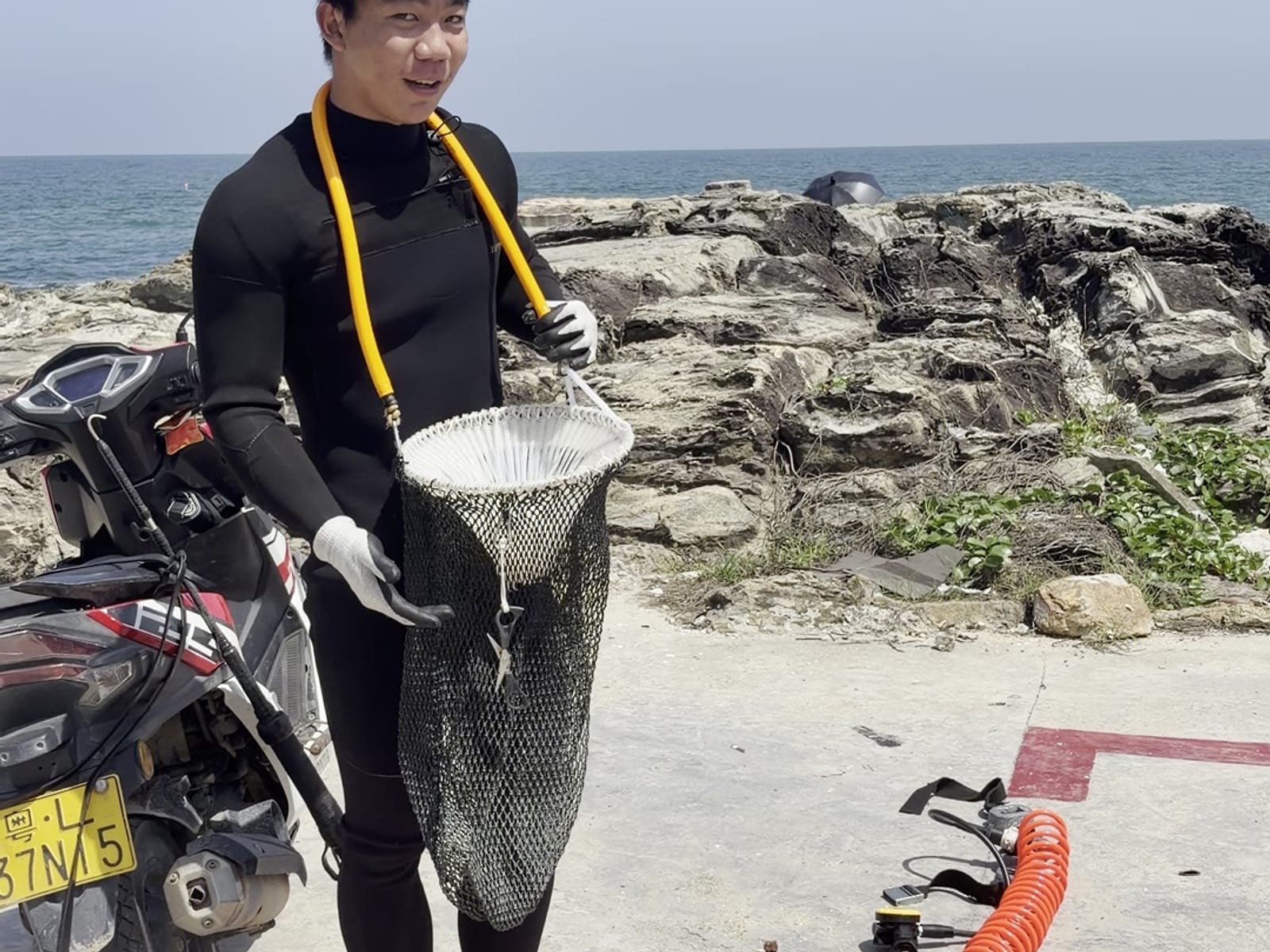
Four tasks, and the order matters. Set: judgement about current and substrate is made on the surface, and in the water it is only fine adjustment. Check: a pass along the gear to confirm nothing has shifted, silted in or been fouled by other gear — the part a breathing apparatus does best, because it is slow and methodical. Take: consolidating the catch, grading it, and returning anything non-compliant. Clear: removing weed, debris and anything large that has found its way in, keeping the gear working at its rated efficiency. Of the four, take and clear are where the time saving is largest, because both are made of a great many small hand movements.
Hose discipline: the one real hazard in this work
The physical danger of gear work is concentrated into a single thing — the relationship between the hose and a rope under load. Pots, set nets and buoy lines are all under tension in a running tide, and a hose that crosses between two loaded ropes does not get entangled in the way a diver expects: it gets gripped. Under tension the ropes close on it, and pulling on the hose is not only useless, it drags the float towards the gear. So this work has exactly one rule that is not negotiable: the hose never crosses a net or a loaded rope, and if you need to be on the other side, you come up, go round and descend again. Two or three extra minutes each time, in exchange for never having the incident.
Returning catch means returning it alive
The compliance requirement most often treated as a formality is the release. Whether a crustacean or a fish survives depends on how quickly and how gently it went back, not on whether it left the boat. The correct practice is to release on the spot rather than bringing it aboard and throwing it back later, because survival in crustaceans falls away markedly after ten minutes of exposure on a deck. Release it low and let it swim or crawl away rather than tossing it from height. This sounds like a detail, but it is the mechanism on which mesh sizes and minimum sizes actually work: the mortality of the released catch is the real performance measure of those rules.

Two habits that raise yield month after month
- Number every pot or net position and record the catch and species mix from each
- Move persistent low performers rather than adding more gear
- Record bycatch: a spike usually means the position or the deployment window is wrong
- Treat clearing as a fixed step, since removing weed and fouling measurably improves the next lift
Why the record is not an administrative burden
Almost everyone experienced in this work does the same thing: they write down what came from each position. On paper that is compliance. The actual return is much larger, because after a few rounds the pattern starts showing itself — which depth band, which sediment transition, which side of the flow is consistently productive. Yield in gear work is mostly a function of position, and position can only be judged from data; judged from memory, the worst pot on the line will stay in the water for a whole season. This is the other way a hose system pays here: you can go and look at the position yourself rather than guessing from the catch.
The short version
- This is the most widely accepted harvesting use for a hose: the rules govern gear, not how you breathe.
- Four tasks: set, check, take, clear. The efficiency gain is concentrated in take and clear.
- The one real hazard is the hose and a loaded rope. A loaded rope grips a hose rather than tangling it.
- Never cross. Go up, round and back down, every time, for two or three extra minutes.
- Release on the spot, quickly, low and gently. Survival is what makes mesh and size limits work.
- Number the positions and record the catch. It beats buying more gear.
FAQ
Do I need a diving certification?
How deep can I go?
What happens if the battery runs low?
Keep reading
Underwater Harvesting 101: What a Hose System Is Actually For
Collection, catching and trap-tending are three different activities with three different rulebooks. The one question that decides which you are doing, and where a hose is welcome rather than banned.

Shrimp and Prawn Harvesting: Two Legal Routes and One That Is Not
Prawns draw the clearest line in the whole harvesting picture. Traps and licensed nets are routine work; pump dredging and electrofishing are not merely unlicensed, they are treated as serious offences.
Hull Cleaning on Surface Supply: A Field Guide
The job that pays for more WOLACH systems than anything else. Depths that matter, working a waterline, hose routing around a berthed boat, and why bottom time changes the economics.